
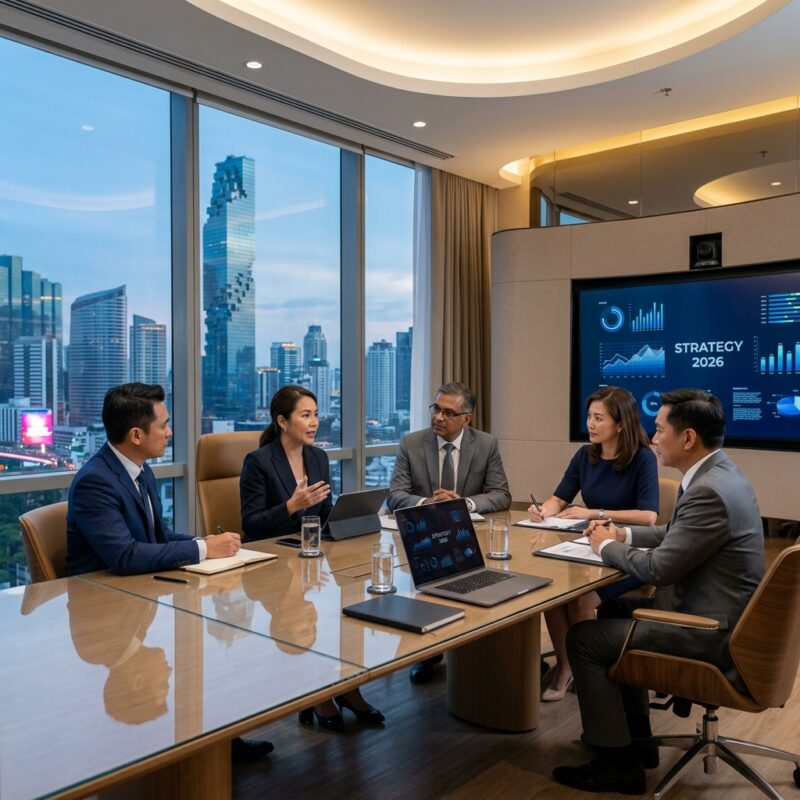
- C-level recruitment Thailand 2026: Market Overview
- What drives C-level recruitment Thailand 2026 demand?
- Key Trends Shaping Executive Search in Thailand
- Digital‑First Sourcing and Assessment
- Emphasis on ESG and Purpose‑Driven Leadership
- Hybrid Work Models and Regional Mobility
- How can companies accelerate executive search in Thailand?
- Why is cultural intelligence critical for C-suite hiring in Thailand?
- Compliance and Regulatory Considerations for Senior Hires
- Leveraging Data Analytics and Technology in Executive Search
- Building a Sustainable Leadership Pipeline
- Partnering with a Specialist Executive Search Firm
C-level recruitment Thailand 2026: Market Overview
The Thai economy continues to diversify beyond tourism and agriculture, with fintech, advanced manufacturing, and renewable energy attracting multinational investment. This shift fuels a heightened need for seasoned executives who can navigate regulatory complexity, drive digital transformation, and manage cross‑border teams. According to the Board of Investment, foreign direct investment inflows rose 12 % year‑over‑year in 2024, signaling sustained demand for C‑suite talent. Companies that anticipate these dynamics early gain a competitive edge in securing leaders who combine global perspective with local market fluency.
In 2025, the average time to fill a chief executive role in Thailand extended to 120 days, up from 95 days in 2022. Lengthy cycles reflect talent scarcity, rigorous vetting, and the need for cultural alignment. Organizations that embed proactive pipeline development into their talent strategy reduce time‑to‑hire by up to 30 %. The data underscores why a structured approach to C-level recruitment Thailand 2026 is no longer optional but a strategic imperative.
What drives C-level recruitment Thailand 2026 demand?
Rapid economic diversification and foreign investment fuel demand for seasoned executives.
Thailand’s Eastern Economic Corridor (EEC) attracts high‑tech manufacturers and logistics operators, each requiring leaders with expertise in supply‑chain optimization, regulatory compliance, and digital innovation. Simultaneously, the fintech boom creates openings for chief technology officers and chief risk officers who can scale platforms while meeting Bank of Thailand regulations. These macro forces converge, expanding the addressable market for C-level recruitment Thailand 2026 across multiple verticals.
Demographic trends amplify the pressure. The working‑age population is plateauing, and the pool of executives with both international exposure and Thai language proficiency remains limited. Organizations increasingly look beyond traditional networks, turning to executive search partners who maintain curated databases of passive candidates across Southeast Asia and beyond.
Key Trends Shaping Executive Search in Thailand
Digital‑First Sourcing and Assessment
AI‑enabled talent mapping now identifies high‑potential leaders by analyzing patent filings, conference speaking engagements, and board memberships. Firms that integrate these signals into their search workflow shorten long‑list creation from weeks to days. However, technology complements—not replaces—human judgment, especially when evaluating cultural fit for C‑suite roles.
Emphasis on ESG and Purpose‑Driven Leadership
Investors and regulators alike demand demonstrable environmental, social, and governance (ESG) credentials. Candidates who have led sustainability transformations or championed inclusive cultures command premium compensation packages. Executive search briefs now routinely include ESG track‑record criteria alongside financial performance metrics.
Hybrid Work Models and Regional Mobility
Post‑pandemic flexibility expectations have reshaped relocation willingness. Many senior leaders prefer a Bangkok base with periodic travel to regional hubs such as Ho Chi Minh City, Kuala Lumpur, or Singapore. Search strategies must therefore articulate clear hybrid‑work policies and career‑path visibility to attract top talent.
How can companies accelerate executive search in Thailand?
Embedding a dedicated talent‑acquisition partner with deep local networks cuts search cycles by up to 40 %.
A specialist firm maintains continuously refreshed candidate pools, conducts pre‑qualification interviews, and manages stakeholder alignment from the outset. This model eliminates the ramp‑up period typical of ad‑hoc internal searches. Moreover, partners bring market intelligence—salary benchmarks, competitor org charts, and regulatory updates—that internal teams rarely possess.
Leveraging a retained search agreement ensures priority access to the firm’s most senior consultants, who can engage passive candidates discreetly. The result is a faster, more predictable hiring timeline, critical when board‑level vacancies threaten strategic initiatives.
Why is cultural intelligence critical for C-suite hiring in Thailand?
Thai business culture values hierarchical respect, consensus‑building, and relationship‑based decision making, which directly affect leadership effectiveness.
Executives who misunderstand “kreng jai” (consideration for others) may inadvertently alienate key stakeholders, slowing transformation agendas. Successful C‑suite hires demonstrate fluency in both formal protocols—such as proper address of senior ministers—and informal networks that drive influence. Assessment frameworks that incorporate cultural simulations, 360‑degree feedback from local peers, and language proficiency checks dramatically improve retention rates.
Research from SHRM shows that culturally aligned leaders achieve 22 % higher employee engagement scores in multinational subsidiaries. Integrating cultural intelligence into the evaluation rubric is therefore a non‑negotiable component of any C-level recruitment Thailand 2026 strategy.
Compliance and Regulatory Considerations for Senior Hires
Thailand’s Labour Protection Act, Foreign Business Act, and sector‑specific licensing requirements create a compliance matrix that varies by industry. For example, a chief financial officer in a banking subsidiary must satisfy Bank of Thailand fit‑and‑proper standards, while a chief operating officer in a manufacturing plant under the EEC must secure Board of Investment work‑permit endorsements.
Executive search partners with in‑house legal counsel can pre‑screen candidates for visa eligibility, tax residency implications, and mandatory social security contributions. Early due diligence prevents costly offer withdrawals and protects employer brand reputation. Companies should also monitor upcoming amendments to the Personal Data Protection Act, which affect background‑check procedures for senior appointments.
Leveraging Data Analytics and Technology in Executive Search
Predictive analytics now forecast candidate acceptance probability by modeling compensation expectations, career trajectory, and market sentiment. Firms that feed real‑time market data into these models improve offer‑to‑acceptance ratios by 15‑20 %. Dashboard tools give hiring committees visibility into pipeline health, diversity metrics, and time‑to‑fill trends.
Integration with HRIS platforms enables seamless transition from candidate selection to onboarding, reducing administrative lag. However, data privacy compliance remains paramount; all analytics must adhere to Thailand’s PDPA and, where applicable, GDPR for multinational candidates.
Building a Sustainable Leadership Pipeline
Succession planning should extend beyond immediate C‑suite vacancies. Identifying high‑potential directors and senior managers two to three levels below the top tier creates a ready bench. Structured leadership development programs—executive coaching, cross‑functional rotations, and board‑shadowing—accelerate readiness.
Organizations that invest in internal mobility report 35 % lower external hiring costs for senior roles. Partnering with a search firm that offers leadership development programs ensures continuity between external market intelligence and internal talent cultivation.
Partnering with a Specialist Executive Search Firm
Choosing a partner with proven sector expertise, a multinational research team, and a transparent fee structure is decisive. Look for firms that publish placement case studies, maintain ISO‑certified quality processes, and offer post‑placement integration support for the first 90 days.
Shelby Global’s home‑market offices in Vietnam and India, combined with documented recruitment experience across Thailand, Malaysia, Indonesia, the Philippines, Japan, Sri Lanka, Mexico, Portugal, Jordan, Mauritius, and African markets, provide a uniquely broad yet locally grounded reach. This footprint enables rapid identification of candidates who meet both technical and cultural criteria for C-level recruitment Thailand 2026 engagements.
Clients benefit from a dedicated research analyst, a senior consultant who leads candidate engagement, and a compliance officer who validates regulatory fit. The result is a streamlined process that delivers qualified shortlists within 30‑45 days for most senior specialist and management roles, and 60‑90 days for C‑suite appointments.
For organizations seeking to future‑proof their leadership ranks, aligning with a firm that blends global reach with deep Thai market insight is the most reliable path to sustainable competitive advantage. McKinsey research confirms that companies with formal executive search partnerships outperform peers on revenue growth by 1.4× over a five‑year horizon.

In summary, the landscape of C-level recruitment Thailand 2026 demands a blend of data‑driven sourcing, cultural intelligence, regulatory rigor, and long‑term pipeline development. Companies that embed these pillars into their talent strategy will secure the visionary leaders needed to capture Thailand’s next growth wave.
Contact Shelby Global today to discuss your C-suite hiring needs. Our experts deliver results.